
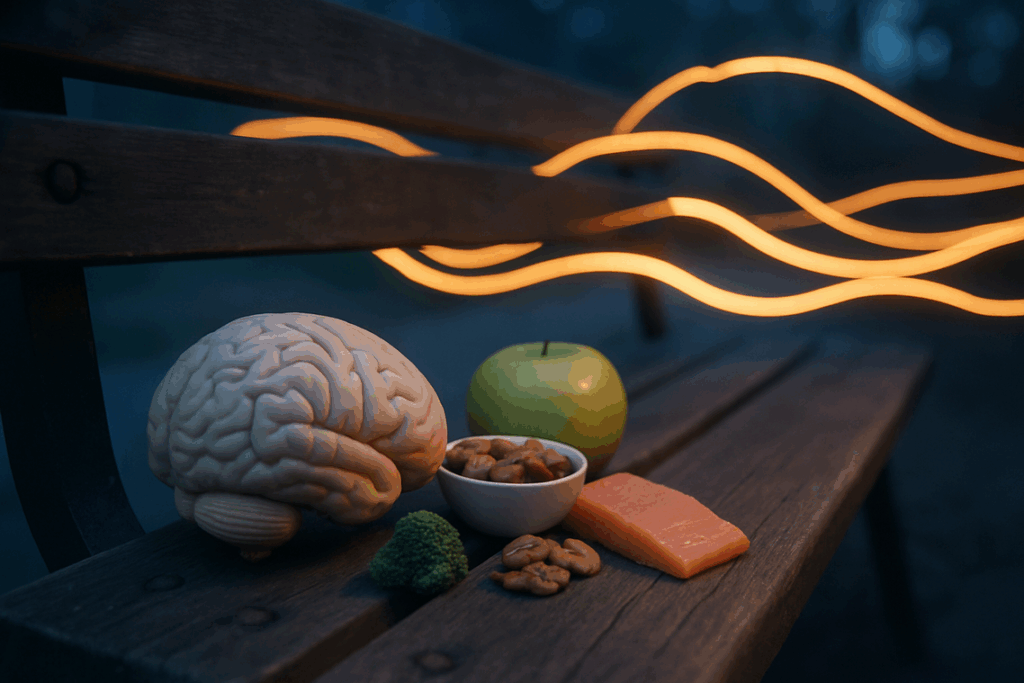
Key Nutrients for Optimal Brain Function
Just as nourishing your body with the right foods can enhance your mental clarity and mood, finding efficient ways to fit exercise into your schedule, such as with Time-Saving Superset Workouts for Busy Professionals, can also play a crucial role in maintaining your mental well-being.
Just as athletes must consider their nutrition to optimize performance and recovery cycles, the foods we choose can significantly impact our mental health and emotional well-being – for more details, check out our Understanding Recovery Cycles in Professional-Level Training.
Your brain burns through about 20% of your daily energy intake, despite making up only ~2% of your body weight (Harvard Medical School). In other words, it’s a high-performance engine—and it runs best on premium fuel.
Omega-3 Fatty Acids
To begin with, omega-3 fatty acids are essential fats your body can’t make on its own. They help build and maintain brain cell membranes and reduce inflammation that can impair cognitive performance. Research published in Nutrients links higher omega-3 intake with improved memory and mood stability.
What’s in it for you? Sharper focus, smoother thinking, and long-term brain resilience.
Sources: fatty fish (like salmon and sardines), walnuts, flaxseeds.
(Pro tip: Aim for two servings of fatty fish per week for meaningful benefits.)
B Vitamins (B6, B9, B12)
Next, these vitamins power energy production and help synthesize neurotransmitters—chemical messengers like serotonin and dopamine that regulate mood. Low B12 levels, for example, have been associated with fatigue and cognitive fog (NIH).
The payoff? More stable energy and a steadier emotional baseline (goodbye, 3 p.m. brain crash).
Sources: leafy greens, eggs, legumes.
Magnesium
Meanwhile, magnesium supports over 300 biochemical reactions in the body, including calming the nervous system and regulating stress responses. Think of it as your brain’s “relaxation mineral.”
The benefit: improved stress tolerance and better sleep quality—both critical for mental clarity.
Sources: almonds, spinach, dark chocolate (yes, the good kind).
Probiotics & Prebiotics
Finally, probiotics (beneficial bacteria) and prebiotics (their fuel) nourish a thriving gut microbiome. This is where the nutrition and mental health connection becomes real: gut health influences mood, cognition, and inflammation through the gut-brain axis (Johns Hopkins Medicine).
Sources: yogurt, kefir (probiotics); garlic, onions, bananas (prebiotics).
Feed your brain well—and it pays you back in focus, resilience, and mental edge.
Your Plate, Your Mind: Taking Control of Your Well-Being
What you put on your plate shapes more than your body—it directly influences your brain. You now understand the powerful nutrition and mental health connection, from the gut-brain axis to the specific nutrients that support balanced mood and sharper focus.
Feeling mentally “off” without a clear reason is frustrating—and common. Low energy, brain fog, irritability—these aren’t random. Often, they’re signals that your brain and gut need better fuel.
The good news? The solution is practical and within reach. When you intentionally choose foods that nourish your brain and digestive system, you create a strong foundation for improved mood, steadier focus, and greater emotional resilience.
Your next step is simple: add one “Mental Champion” food to your very next meal. Start small. Stay consistent. Pay attention to how you feel.
Your well-being is in your hands—and it begins with your next bite.
 There is a specific skill involved in explaining something clearly — one that is completely separate from actually knowing the subject. Martine Mendenhalleys has both. They has spent years working with holistic wellness strategies in a hands-on capacity, and an equal amount of time figuring out how to translate that experience into writing that people with different backgrounds can actually absorb and use.
Martine tends to approach complex subjects — Holistic Wellness Strategies, Health Innovation Alerts, Pro Insights being good examples — by starting with what the reader already knows, then building outward from there rather than dropping them in the deep end. It sounds like a small thing. In practice it makes a significant difference in whether someone finishes the article or abandons it halfway through. They is also good at knowing when to stop — a surprisingly underrated skill. Some writers bury useful information under so many caveats and qualifications that the point disappears. Martine knows where the point is and gets there without too many detours.
The practical effect of all this is that people who read Martine's work tend to come away actually capable of doing something with it. Not just vaguely informed — actually capable. For a writer working in holistic wellness strategies, that is probably the best possible outcome, and it's the standard Martine holds they's own work to.
There is a specific skill involved in explaining something clearly — one that is completely separate from actually knowing the subject. Martine Mendenhalleys has both. They has spent years working with holistic wellness strategies in a hands-on capacity, and an equal amount of time figuring out how to translate that experience into writing that people with different backgrounds can actually absorb and use.
Martine tends to approach complex subjects — Holistic Wellness Strategies, Health Innovation Alerts, Pro Insights being good examples — by starting with what the reader already knows, then building outward from there rather than dropping them in the deep end. It sounds like a small thing. In practice it makes a significant difference in whether someone finishes the article or abandons it halfway through. They is also good at knowing when to stop — a surprisingly underrated skill. Some writers bury useful information under so many caveats and qualifications that the point disappears. Martine knows where the point is and gets there without too many detours.
The practical effect of all this is that people who read Martine's work tend to come away actually capable of doing something with it. Not just vaguely informed — actually capable. For a writer working in holistic wellness strategies, that is probably the best possible outcome, and it's the standard Martine holds they's own work to.