

If you’re searching for a practical way to improve flexibility, reduce stiffness, and move without pain, you’re likely looking for a routine that actually fits into your everyday life. This article is designed to give you exactly that: a clear, effective approach to shoulder mobility exercises daily that supports strength, stability, and long-term joint health.
Shoulder mobility isn’t just for athletes. Whether you sit at a desk, train regularly, or simply want to prevent discomfort, consistent mobility work can improve posture, enhance performance, and lower injury risk. The challenge is knowing which movements matter and how to perform them correctly.
To ensure accuracy and effectiveness, this guide draws on established exercise science principles, physical therapy best practices, and proven mobility frameworks used in performance training. You’ll learn why daily shoulder mobility matters, which exercises deliver the greatest benefit, and how to structure a routine that supports lasting results.
Unlock Your Shoulders: Move Freely and Live Pain-Free
Stiff neck after hours at your desk? Struggling to reach a high shelf or feeling a sharp twinge putting on a jacket? You’re not alone. Modern, screen-heavy living is quietly shrinking your shoulder’s natural range of motion (how far your joint moves comfortably). Over time, LIMITED MOBILITY leads to pain and higher injury risk (yes, even from simple tasks).
The fix doesn’t require intense gym sessions. This guide shows you how to use shoulder mobility exercises daily to restore movement, reduce discomfort, and BUILD RESILIENT SHOULDERS with simple, practical motions you can fit into any schedule.
Why Healthy Shoulders Are Your Everyday Superpower
Healthy shoulders quietly shape your posture. When shoulder muscles tighten, they pull the head forward and round the upper back—a pattern called upper cross syndrome (a common postural imbalance). Over time, that strain travels to the neck and lower back, often leading to chronic pain (Harvard Health notes poor posture is linked to musculoskeletal discomfort).
Just as importantly, the body works as a kinetic chain—a system where joints and muscles influence one another. If your shoulders lack mobility (active, controlled range of motion), your grip strength, breathing efficiency, and even core stability can suffer. Flexibility is passive; mobility is usable strength.
Consider everyday life:
- Carrying groceries overhead stresses stiff shoulders.
- Playing with kids demands rotation and stability.
- Driving requires sustained shoulder positioning.
So what can you do? Practice shoulder mobility exercises daily, focus on thoracic spine extension, and reset posture every hour (yes, even mid-Netflix). Small adjustments, repeated consistently, build resilient shoulders—and a stronger, pain-free chain.
Your 5-Minute Daily Shoulder Mobility Toolkit
Shoulders are complex joints, meaning they trade stability for mobility. That’s great for throwing a ball or reaching overhead—but it also makes them vulnerable to stiffness and strain. This five-move sequence is designed to restore balance in just minutes. Use shoulder mobility exercises daily to maintain healthy movement, reduce discomfort, and improve posture.
Exercise 1: Wall Slides
Stand with your back flat against a wall, feet slightly forward, knees soft. Press your lower back gently into the wall to avoid arching. Bring your arms up so elbows and wrists touch the wall in a goalpost position. Slowly slide them upward, then back down, keeping contact throughout.
The goal is activating the lower trapezius (muscles that stabilize the shoulder blades) and the serratus anterior (the muscle that helps your shoulder blade glide smoothly). If your lower back arches or wrists peel off, you’re compensating. (Your ego might want higher arms; your shoulders want control.)
Benefit: Improves overhead mobility while reinforcing proper scapular mechanics.
Exercise 2: Thoracic Spine Rotations (Quadruped)
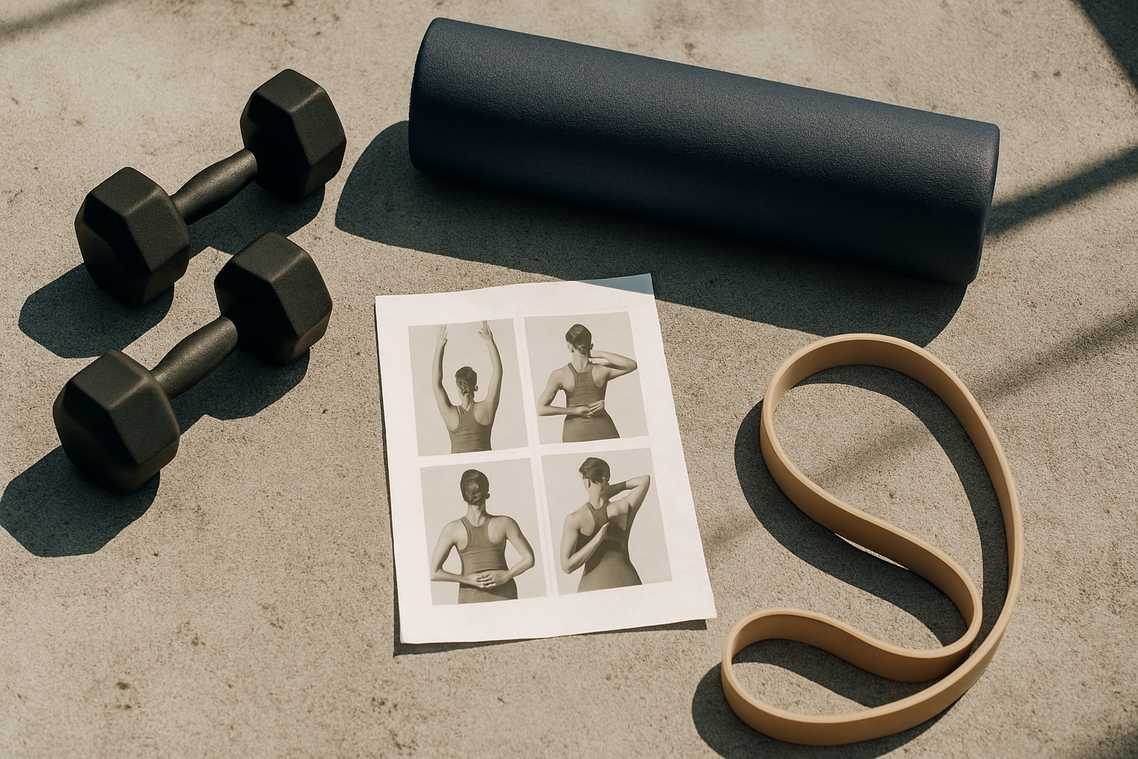
Start on hands and knees, wrists under shoulders, knees under hips. Place one hand behind your head. Rotate your elbow down toward the opposite wrist, then open it toward the ceiling, following the motion with your eyes.
Focus on moving through the thoracic spine—the upper and mid-back—not the lower back. The thoracic spine is often stiff from prolonged sitting, and limited rotation here forces the shoulders to overwork. This drill “unglues” that stiffness, restoring rotational capacity essential for pressing and pulling movements.
Benefit: Enhances upper-back rotation, reducing excess strain on the shoulder joint.
Exercise 3: Cat-Cow Stretch
From the same hands-and-knees position, inhale as you drop your belly and lift your chest (Cow). Exhale as you round your spine toward the ceiling (Cat). Move slowly and deliberately.
This foundational drill mobilizes the spine while training protraction (shoulder blades spreading apart) and retraction (shoulder blades squeezing together). Healthy shoulder function depends on these coordinated scapular movements. Without them, pressing and pulling become inefficient and potentially painful.
Benefit: Promotes fluid spinal and scapular motion, supporting joint longevity.
Exercise 4: Doorway Pectoral Stretch
Stand in a doorway and place your forearms on the frame, elbows roughly at shoulder height. Step one foot forward and gently lean through until you feel a stretch across your chest.
Tight pectoralis muscles (pecs) pull the shoulders forward into a slumped posture—common in desk workers and frequent phone users. To modify intensity, adjust elbow height or step closer to the frame. Stretching restores length to the chest, allowing the upper back muscles to engage properly.
Benefit: Counters rounded shoulders and improves upright posture.
Exercise 5: Band Pull-Aparts
Hold a light resistance band with arms straight out in front of you at chest height. Pull the band apart until it touches your chest, squeezing your shoulder blades together, then return slowly.
This strengthens the rhomboids and rear deltoids, key stabilizers that support shoulder alignment. Keep ribs down and avoid shrugging. A lighter band with strict form beats a heavy band with momentum (quality over quantity wins every time).
- Perform 10–15 controlled reps
- Keep shoulders down and neck relaxed
- Focus on steady tension
Benefit: Builds upper-back strength for long-term shoulder stability.
For a broader approach, explore these dynamic stretching routines to improve joint mobility to complement your daily toolkit.
Five minutes. Five movements. Stronger, more resilient shoulders.
How to Weave These Movements into Your Daily Life
First, start with a simple “Micro-Routine.” Perform shoulder mobility exercises daily as soon as you wake up to counteract overnight stiffness. Research shows that just 5–10 minutes of morning mobility work can improve joint range of motion and reduce discomfort throughout the day (American College of Sports Medicine). Try:
- 10–12 repetitions of band pull-aparts
- 10–12 controlled arm circles per direction
- 30-second doorway chest stretches
If mornings feel rushed, break the routine into “workout snacks.” For example, do doorway stretches each time you leave your office or complete band pull-aparts during a coffee break. Studies on movement breaks suggest short activity bouts improve circulation and reduce musculoskeletal strain in desk workers (Journal of Occupational Health).
Set clear parameters: focus on control, not heavy resistance. Progress gradually by adding 2–3 reps or extending holds by 5–10 seconds weekly. Consistency—not intensity—is the real game changer (think slow burn, not superhero montage).
Your goal of moving through each day without stiffness is absolutely achievable. Shoulder tightness is common—studies estimate that up to 67% of adults experience shoulder pain at some point (BMJ). Yet this isn’t something you have to accept. This toolkit works because it addresses both sides: stretching the shortened muscles that restrict motion and strengthening the weaker stabilizers that protect the joint. As a result, movement feels smoother and more supported. So start small—commit to shoulder mobility exercises daily and pick one move right now to begin lasting change. Your future self will thank you. Trust the process.
Build Stronger, Pain-Free Shoulders Starting Today
You came here looking for a clear, practical way to improve your shoulder health—and now you have it. By understanding how mobility, stability, and strength work together, you’re no longer guessing your way through workouts or ignoring the stiffness and tightness holding you back.
Shoulder discomfort, limited range of motion, and nagging tension don’t just affect your workouts—they impact how you move every single day. Left unchecked, those small restrictions can turn into chronic pain, poor posture, and stalled progress in the gym.
The good news? You don’t need complicated routines or hours of extra training. Adding shoulder mobility exercises daily is a simple, powerful step that keeps your joints healthy, improves performance, and reduces your risk of injury. Consistency is what transforms tight, restricted shoulders into strong, fluid, pain-free movement.
Now it’s your move. Commit to practicing shoulder mobility exercises daily, follow a structured plan designed for long-term joint health, and take control of your performance before discomfort slows you down. Join thousands who are prioritizing smarter movement and lasting results—start today and feel the difference in every lift, stretch, and stride.
 There is a specific skill involved in explaining something clearly — one that is completely separate from actually knowing the subject. Martine Mendenhalleys has both. They has spent years working with holistic wellness strategies in a hands-on capacity, and an equal amount of time figuring out how to translate that experience into writing that people with different backgrounds can actually absorb and use.
Martine tends to approach complex subjects — Holistic Wellness Strategies, Health Innovation Alerts, Pro Insights being good examples — by starting with what the reader already knows, then building outward from there rather than dropping them in the deep end. It sounds like a small thing. In practice it makes a significant difference in whether someone finishes the article or abandons it halfway through. They is also good at knowing when to stop — a surprisingly underrated skill. Some writers bury useful information under so many caveats and qualifications that the point disappears. Martine knows where the point is and gets there without too many detours.
The practical effect of all this is that people who read Martine's work tend to come away actually capable of doing something with it. Not just vaguely informed — actually capable. For a writer working in holistic wellness strategies, that is probably the best possible outcome, and it's the standard Martine holds they's own work to.
There is a specific skill involved in explaining something clearly — one that is completely separate from actually knowing the subject. Martine Mendenhalleys has both. They has spent years working with holistic wellness strategies in a hands-on capacity, and an equal amount of time figuring out how to translate that experience into writing that people with different backgrounds can actually absorb and use.
Martine tends to approach complex subjects — Holistic Wellness Strategies, Health Innovation Alerts, Pro Insights being good examples — by starting with what the reader already knows, then building outward from there rather than dropping them in the deep end. It sounds like a small thing. In practice it makes a significant difference in whether someone finishes the article or abandons it halfway through. They is also good at knowing when to stop — a surprisingly underrated skill. Some writers bury useful information under so many caveats and qualifications that the point disappears. Martine knows where the point is and gets there without too many detours.
The practical effect of all this is that people who read Martine's work tend to come away actually capable of doing something with it. Not just vaguely informed — actually capable. For a writer working in holistic wellness strategies, that is probably the best possible outcome, and it's the standard Martine holds they's own work to.